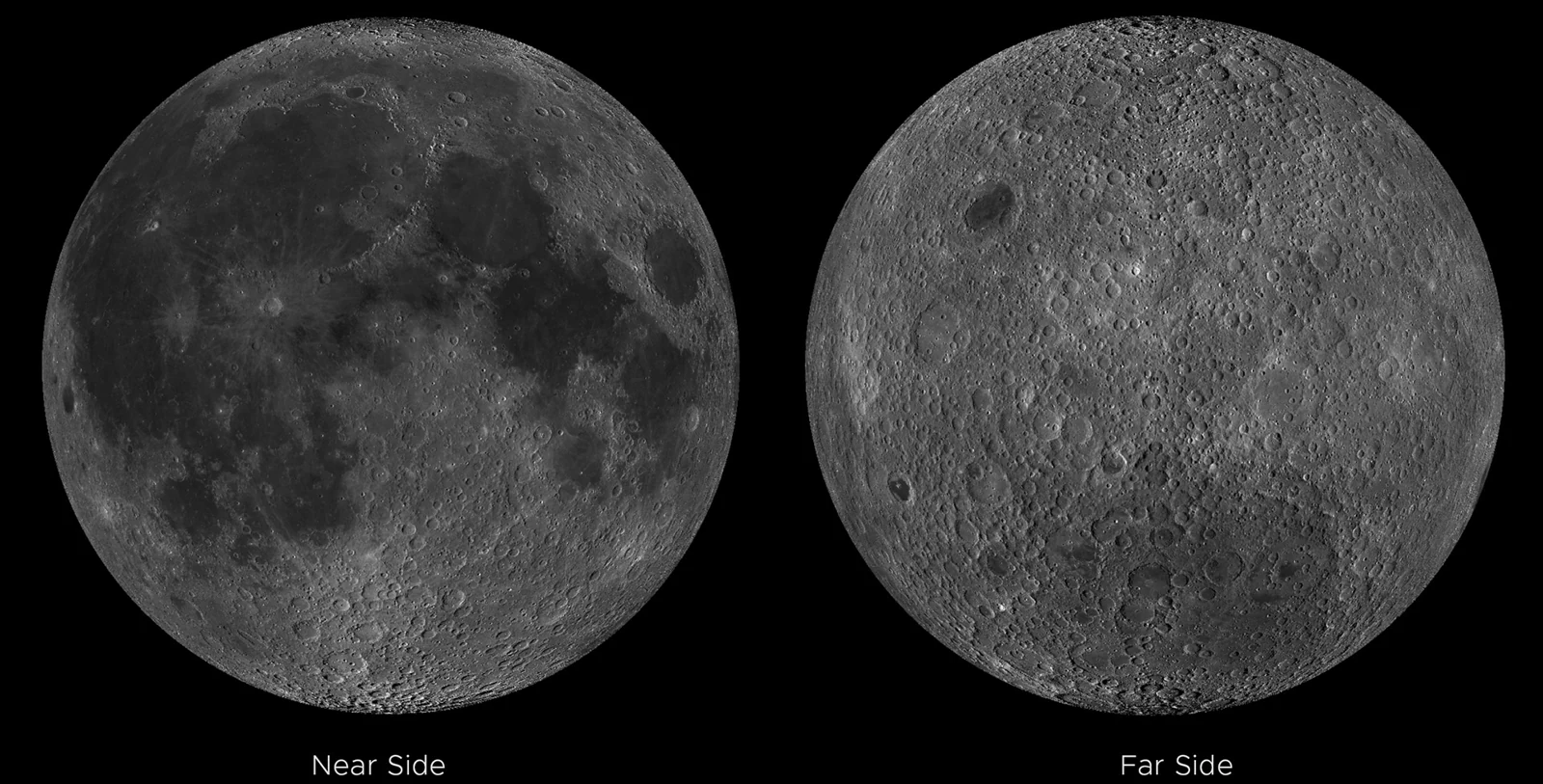
Open my lunar log →NASA/Goddard/Arizona State University · LRO. “Near Side”: the side facing Earth; “Far Side”: the opposite side. · Click to enlarge.
Accessible to the naked eye100 features to exploreIllustrations from volume II
Vision and light
Always the same side?
The Moon rotates once as it completes one orbit around Earth: this synchronous rotation almost always presents the same hemisphere to us. Libration lets us glimpse a little more of its edges over time.
The far side is not always dark. It also experiences day and night.
Phase workshop
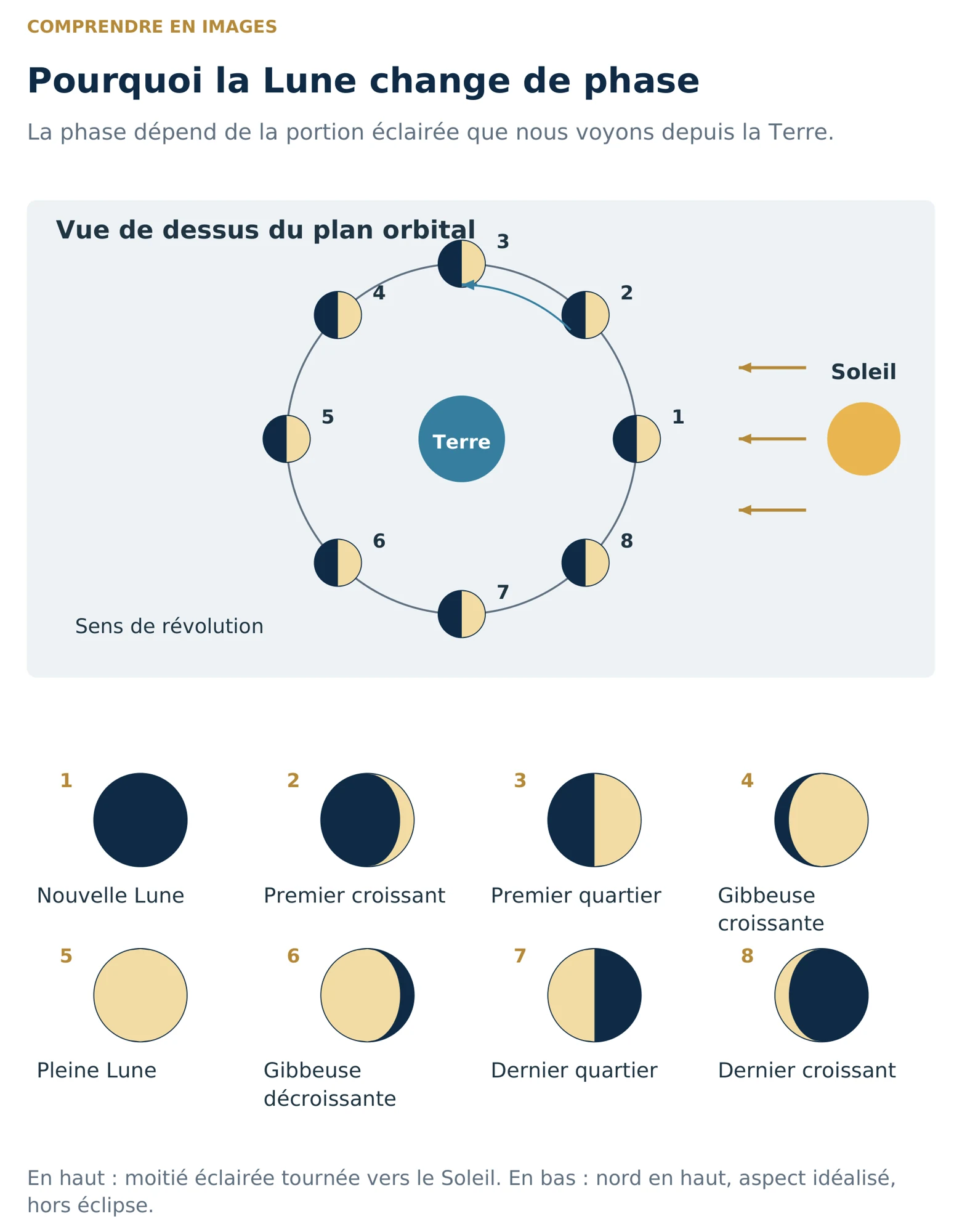
One Moon, eight faces.
The Sun illuminates half of the Moon. From Earth, we see a different portion over the cycle. Ordinary phases are not caused by Earth’s shadow.
Choose a phase to explore it. These diagrams are educational, north up and outside an eclipse: they give neither the current phase nor local times. In the sky, the disc may appear tilted; your instrument may invert the image.
The side facing us is in darkness. The Moon lies close to the Sun’s direction: do not search for it with a telescope near the Sun.
Prepare your next session or explore the deep sky.
The right side is illuminated in this north-up view. The illuminated portion is increasing.
After sunset, compare the curve of the limb with that of the terminator.
Half of the visible disc is illuminated. The Sun lights the terrain at a low angle near the terminator.
Choose a crater at the edge of night and draw its shadows.
More than half the disc is illuminated, and the lit area continues to grow.
Find the maria you have already identified and look for changes in shadows.
The disc is almost fully illuminated outside an eclipse. The terrain appears flatter.
Compare dark and bright regions; follow the rays around Tycho.
After full Moon, the illuminated portion shrinks. The left side is illuminated in this view.
Compare the same region with your drawing from the waxing phase.
Half the disc is illuminated again, on the other side. Shadows reveal lighting from the opposite direction.
Prepare a late-night or morning observation, keeping the Sun out of the field of view.
The illuminated portion becomes thin before new Moon.
Prefer an observation before sunrise; never sweep an instrument in the Sun’s direction.
View the book’s orbital diagramVolume II · Diagram not to scale, idealised orientation. · Click to enlarge.
Adapted from the “La Lune” chapter of Steve Cimolino’s volume II, Comprendre comment explorer le ciel, manuscript dated 17 October 2026. The plates come from the book and have been resized for the web.
Photographs of both sides: NASA/Goddard/Arizona State University (LRO), Synchronous rotation. Annotated map: NASA photograph, Moon Phases, book annotations and approximate markers. Phase diagram: educational plate from volume II. NASA image use guidelines.