A modular family ranging from light to heavy launches.
Angara is a Russian family developed by the Khrunichev centre. It uses common modules to adapt the launcher to several payload classes, mainly satellites without crews.
RussiaCountry or programme
2014First flight / test
No crewed flightHuman spaceflight
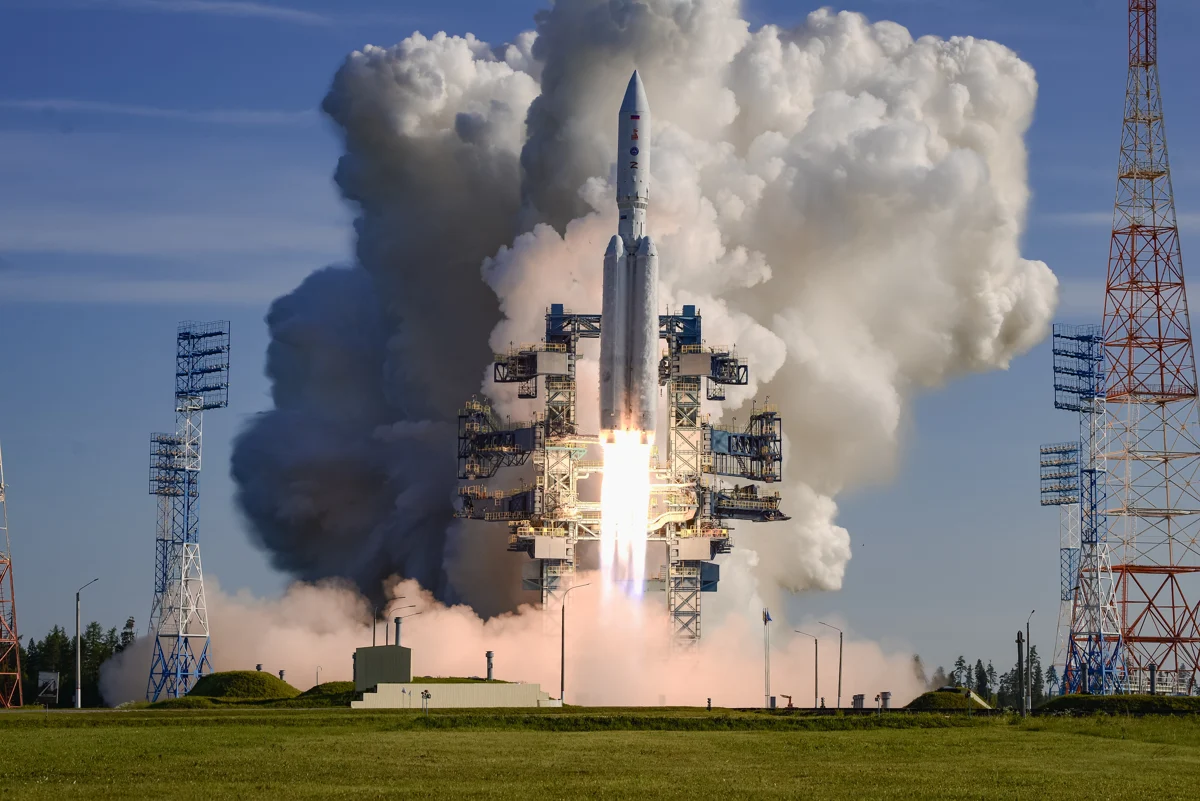
Angara-A5 lifting off from Plesetsk, June 2025. · Ministry of Defence of the Russian Federation / Mil.ru · Source · CC BY 4.0 · Resized and converted to WebP; original proportions preserved.
A history of launches
The inaugural test from Plesetsk in July 2014 follows a suborbital trajectory with a dummy payload. It checks the stages' operation without attempting to place a satellite into orbit.
In December 2014, the heavy Angara A5 version makes its first flight. A Briz-M upper stage takes its demonstration payload toward geostationary orbit, showing a different capability from the initial test.
Missions and crews
Selected representative missions; crew names belong to the flight shown.
2014-07-09
Angara 1.2PP · essai inaugural
The 1.2PP demonstrator flies a ballistic trajectory toward the Kamchatka test area.
Crew of this missionUncrewed mission
2014-12-23
Angara A5 · premier vol
Angara A5's first test carries a simulated payload, without an operational satellite or cosmonauts.
Crew of this missionUncrewed mission
Dates follow the days reported by the source agencies, generally in local time; the UTC day can differ. Crews belong to the selected missions, not every flight in the family.
What this work changed
Angara shows how component standardisation can support a range of launches and access to space from Russian territory.
First flight or first test of the family, including unsuccessful or suborbital attempts.