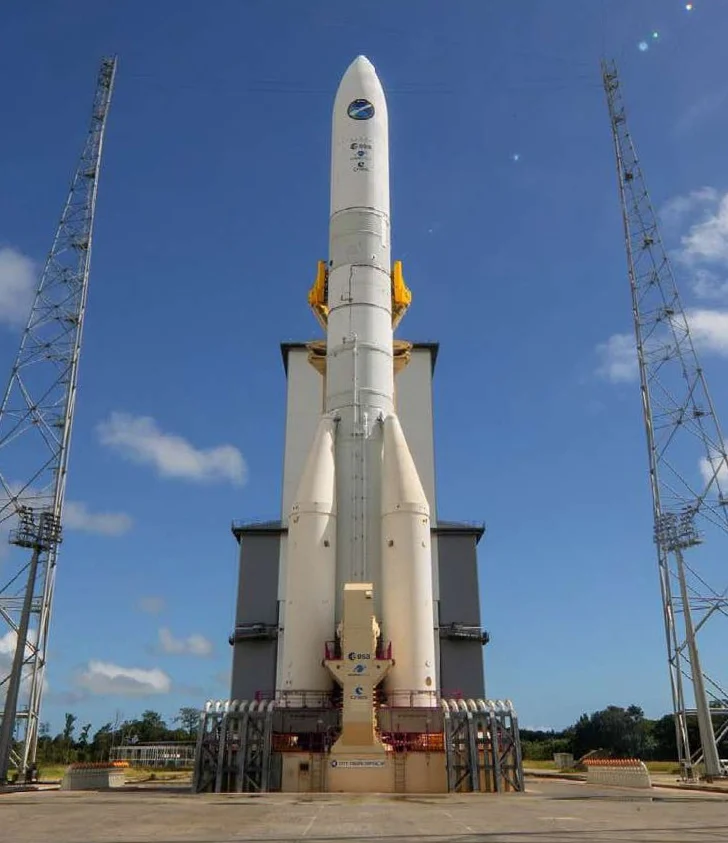
Ariane 6 succeeds Ariane 5 in providing European access to space. It is designed to launch institutional, scientific and commercial satellites, without carrying people.
EuropeCountry or programme
2024First flight / test
No crewed flightHuman spaceflight
Ariane 6 on its launch pad at Kourou. · ESA / M. Pedoussaut · Source · CC BY-SA 3.0 IGO · Crop and rotation by RickyCourtney; resized and converted to WebP.
A history of launches
The first flight in July 2024 reaches orbit and deploys payloads. An anomaly nevertheless prevents completion of all the planned upper-stage operations.
The second flight, in March 2025, delivers the CSO-3 satellite and demonstrates the upper stage's end-of-mission operations. These completed milestones should be distinguished from the programme's original ambitions.
Missions and crews
Selected representative missions; crew names belong to the flight shown.
2024-07-09
Ariane 6 · VA262
The inaugural flight reaches orbit, but the final upper-stage sequence remains incomplete.
Crew of this missionUncrewed mission
2025-03-06
Ariane 6 · CSO-3
The first commercial flight carries the French CSO-3 Earth-observation satellite.
Crew of this missionUncrewed mission
Dates follow the days reported by the source agencies, generally in local time; the UTC day can differ. Crews belong to the selected missions, not every flight in the family.
What this work changed
The family continues Europe's pursuit of autonomous access through shared infrastructure and industrial cooperation.
First flight or first test of the family, including unsuccessful or suborbital attempts.