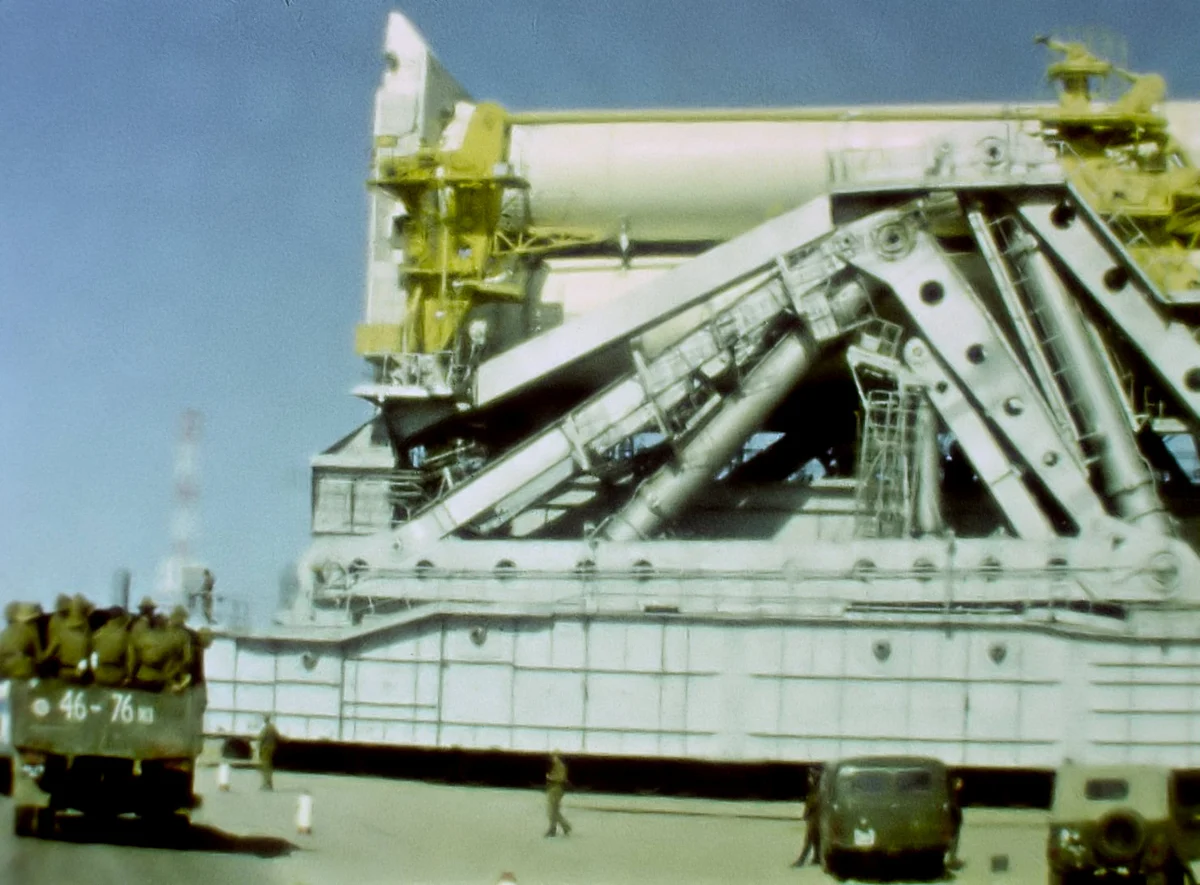
A giant launcher separate from the shuttle it carries.
Energia is a Soviet heavy launcher designed for bulky payloads, including the Buran shuttle. The launch vehicle and the orbiter are distinct components of the programme.
USSRCountry or programme
1987First flight / test
No crewed flightHuman spaceflight
Energia on its transporter heading to the launch pad; frame from a 1987 film. · Аркадий Тарасов · Source · CC BY-SA 3.0 · Resized and converted to WebP; original proportions preserved.
A history of launches
Its first flight in 1987 carries Polyus. The rocket completes its powered phase, but the payload fails to perform its own orbital insertion correctly.
In 1988, Energia launches Buran on its only space mission. The orbiter circles Earth twice and lands automatically, with no cosmonauts aboard. The system never flies again.
Missions and crews
Selected representative missions; crew names belong to the flight shown.
1987-05-15
Polyus
Energia's first test; Polyus's failed insertion is a payload failure.
Crew of this missionUncrewed mission
1988-11-15
Bourane / Buran
Buran flies entirely automatically and without a crew: a spacecraft designed for people can be tested alone.
Crew of this missionUncrewed mission
Dates follow the days reported by the source agencies, generally in local time; the UTC day can differ. Crews belong to the selected missions, not every flight in the family.
What this work changed
The architecture illustrates a different way to separate heavy transport from the task of bringing a reusable spacecraft home.
First flight or first test of the family, including unsuccessful or suborbital attempts.