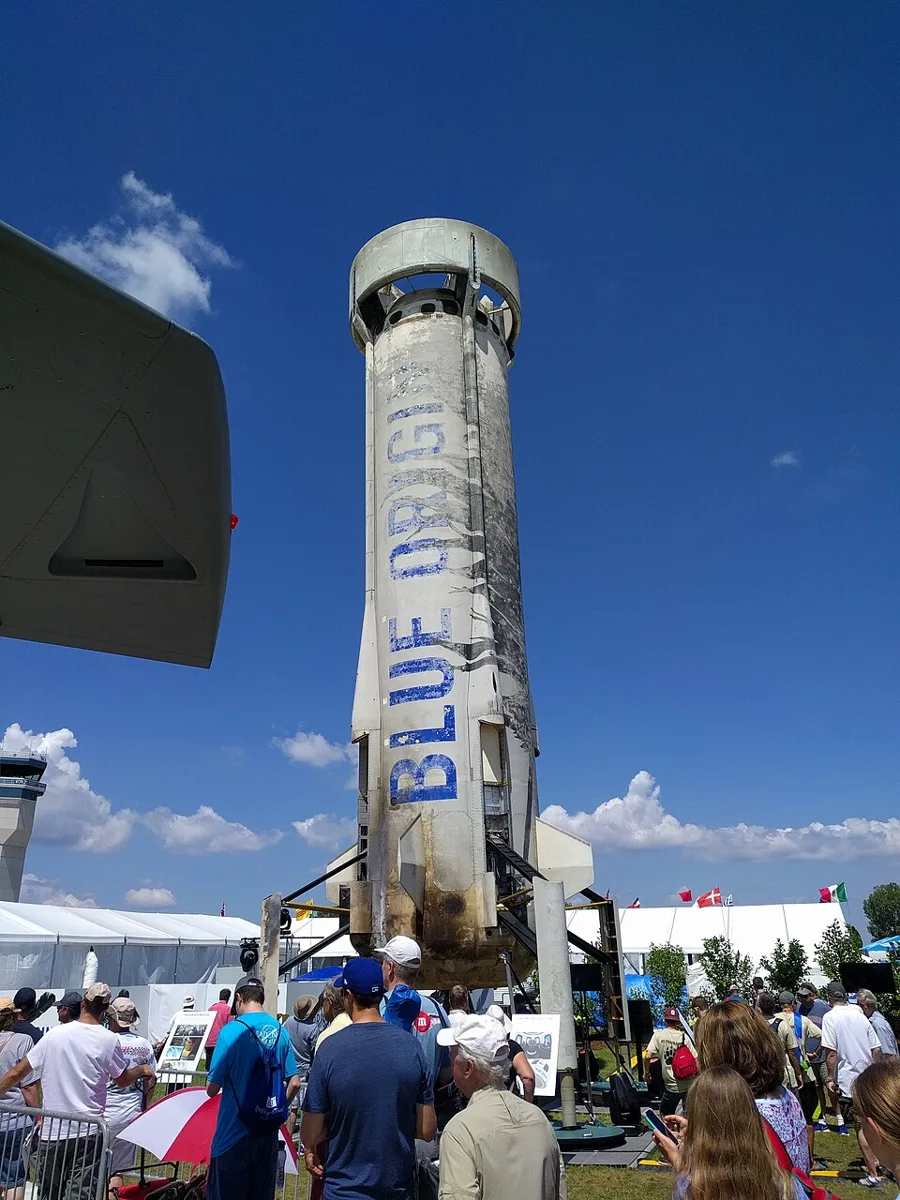
New Shepard is Blue Origin's reusable suborbital system. Named after Alan Shepard, the first American in space, it consists of a rocket and a separate capsule.
United StatesCountry or programme
2015First flight / test
Has carried humansHuman spaceflight
New Shepard displayed at Oshkosh · 2017 · ThePenultimateOne · Source · CC BY-SA 4.0 · Image resized and converted to WebP.
A history of launches
Testing begins in 2015. In November that year, the booster returns for a vertical landing after carrying the capsule above one hundred kilometres in altitude.
The first flight with people aboard takes place in July 2021. Other flights carry scientific experiments; a suborbital flight must not be confused with a mission to the ISS.
Missions and crews
Selected representative missions; crew names belong to the flight shown.
2015-11-23
NS-2 · atterrissage du propulseur
An unoccupied flight successfully recovers the booster through a vertical landing.
Crew of this missionUncrewed mission
2021-07-20
NS-16 · premier vol habité
Four passengers take the system's first crewed flight; none enters Earth orbit.
Crew of this missionJeff Bezos · Mark Bezos · Wally Funk · Oliver Daemen
Dates follow the days reported by the source agencies, generally in local time; the UTC day can differ. Crews belong to the selected missions, not every flight in the family.
What this work changed
It provides opportunities to study brief microgravity and develop reusable flight operations.
First flight or first test of the family, including unsuccessful or suborbital attempts.