The heavy transporter of Soviet stations and probes.
Proton becomes a mainstay of heavy Soviet and later Russian launches. Despite its essential role in crewed space stations, this rocket family never launches cosmonauts directly.
USSR / RussiaCountry or programme
1965First flight / test
No crewed flightHuman spaceflight
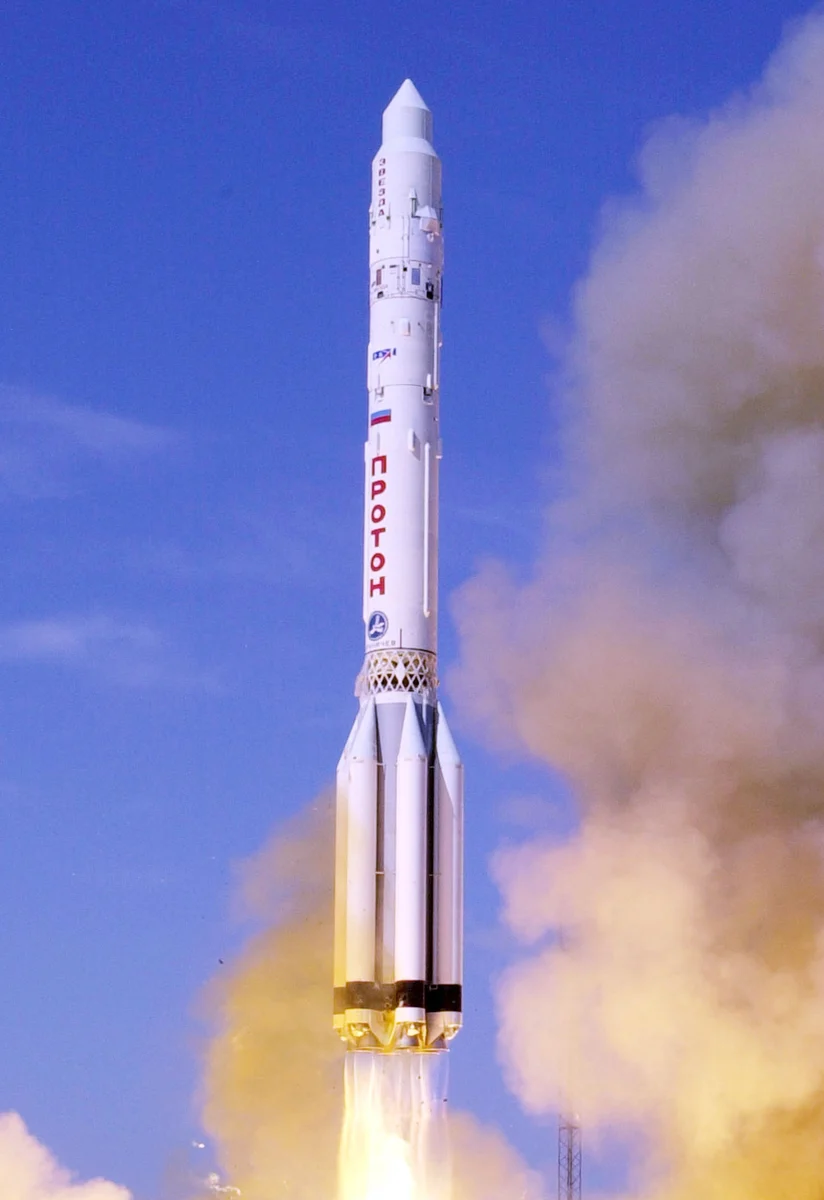
Proton-K launching the Zvezda module in 2000. · NASA · Source · Public domain · Resized and converted to WebP; original proportions preserved.
A history of launches
Its name comes from the Proton scientific satellites, which study high-energy particles. The first launches in 1965, beginning a long evolution of the launch vehicle.
Later versions send interplanetary probes, communications satellites and station modules into space. In 1998, Proton launches Zarya, the first element placed in orbit for the ISS.
Missions and crews
Selected representative missions; crew names belong to the flight shown.
1965-07-16
Proton 1
The scientific satellite that gives the rocket its name measures cosmic radiation.
Crew of this missionUncrewed mission
1998-11-20
Zarya
The Zarya module reaches orbit uncrewed; astronauts arrive later aboard other vehicles.
Crew of this missionUncrewed mission
Dates follow the days reported by the source agencies, generally in local time; the UTC day can differ. Crews belong to the selected missions, not every flight in the family.
What this work changed
Proton shows how a human space station can be assembled from separate components launched without occupants.
First flight or first test of the family, including unsuccessful or suborbital attempts.