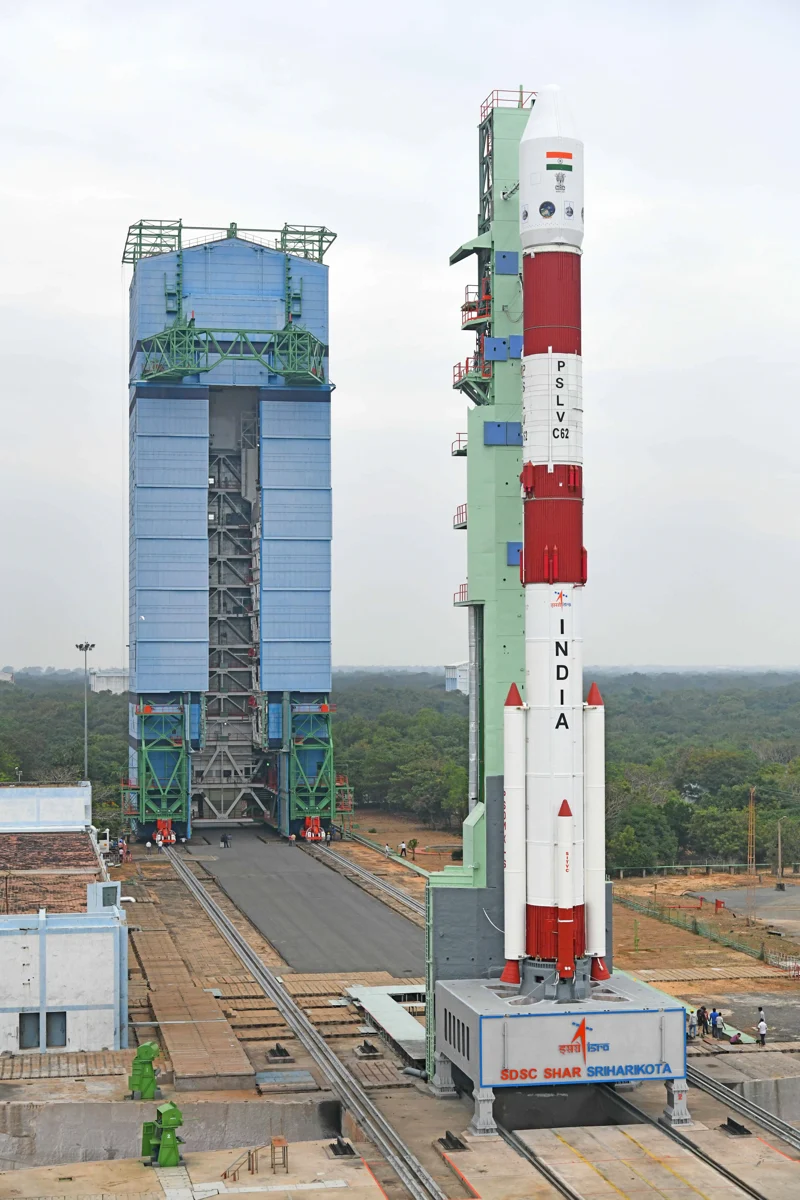
India's launcher opening routes to the Moon and Mars.
PSLV stands for Polar Satellite Launch Vehicle. Designed particularly for observation satellites, it becomes an adaptable ISRO launcher for scientific and commercial payloads, without crews.
IndiaCountry or programme
1993First flight / test
No crewed flightHuman spaceflight
PSLV-C62 before launch. · ISRO, Department of Space, Government of India · Source · GODL-India · Resized and converted to WebP; original proportions preserved.
A history of launches
The first test in 1993 fails; the second, in 1994, succeeds. The family subsequently serves different orbits and can deploy several satellites during one flight.
PSLV launches Chandrayaan-1 in 2008 and Mars Orbiter Mission in 2013. These probes do not simply fly straight to their destinations: their own engines and carefully planned navigation complete the initial launch.
Missions and crews
Selected representative missions; crew names belong to the flight shown.
2008-10-22
Chandrayaan-1 · PSLV-C11
India's first lunar mission carries Indian and international scientific instruments.
Crew of this missionUncrewed mission
2013-11-05
Mars Orbiter Mission · PSLV-C25
The Mars probe begins its mission from an initial Earth orbit, with no astronauts aboard.
Crew of this missionUncrewed mission
Dates follow the days reported by the source agencies, generally in local time; the UTC day can differ. Crews belong to the selected missions, not every flight in the family.
What this work changed
PSLV illustrates the gradual development of space autonomy and the use of one launcher for Earth observation and distant exploration.
First flight or first test of the family, including unsuccessful or suborbital attempts.