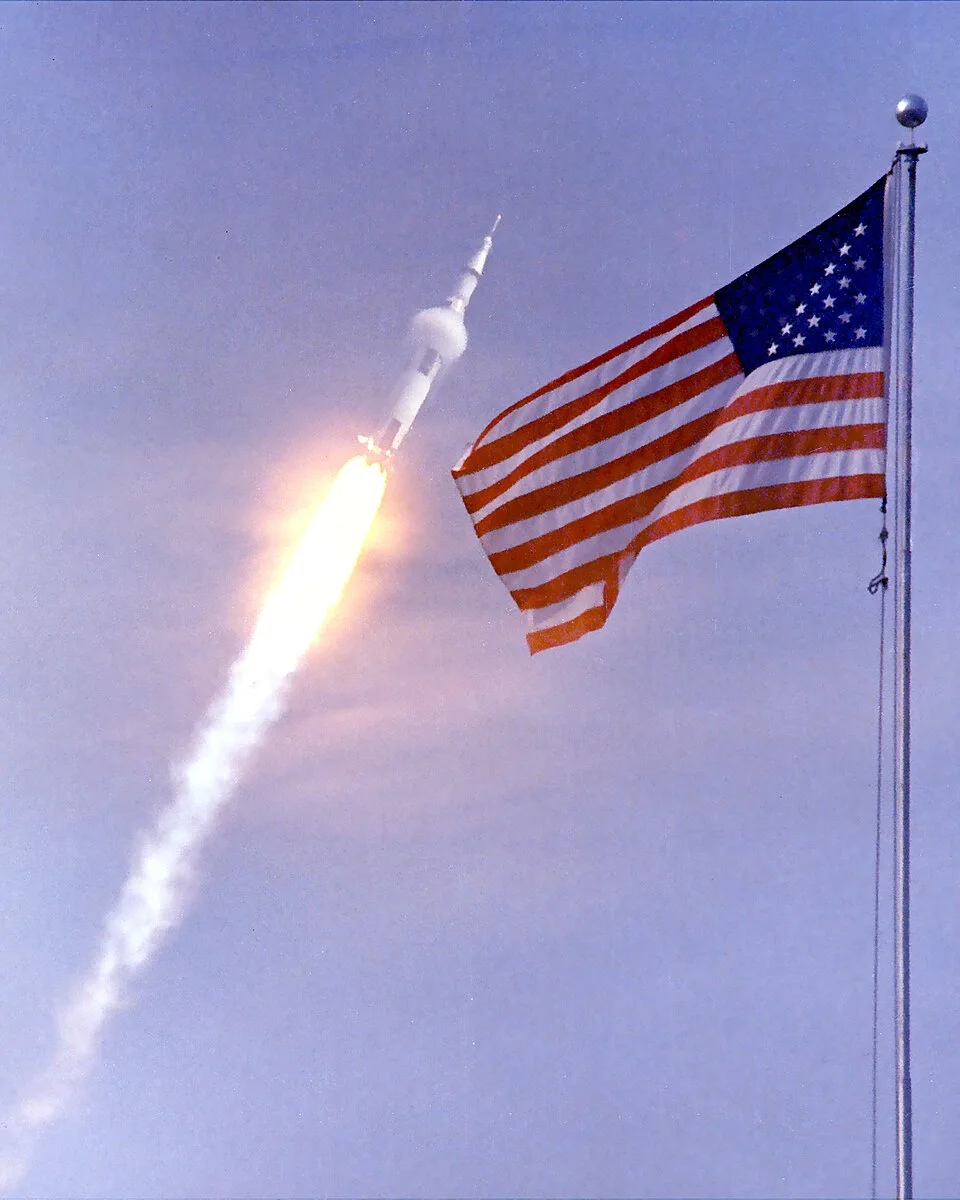
The rocket behind humanity's first lunar footsteps.
Saturn V is the giant launcher of the Apollo programme. It sends a spacecraft assembly toward the Moon; the spacecraft modules, rather than the complete rocket, continue the expedition.
United StatesCountry or programme
1967First flight / test
Has carried humansHuman spaceflight
Saturn V · Apollo 11 · 1969 · NASA · Source · Public domain · Image resized and converted to WebP.
A history of launches
Developed under NASA's Marshall Space Flight Center, it makes its first complete test flight in 1967. Apollo 8 then carries the first humans around the Moon in 1968.
Apollo 11 achieves the first landing in 1969. Later flights extend scientific exploration; a modified Saturn V also launches the uncrewed Skylab station in 1973.
Missions and crews
Selected representative missions; crew names belong to the flight shown.
1967-11-09
Apollo 4
An uncrewed test of the complete launcher and Apollo spacecraft, including a high-speed atmospheric return.
Crew of this missionUncrewed mission
1969-07-16
Apollo 11
Armstrong and Aldrin walk on the Moon while Collins remains in lunar orbit in the command module.
Crew of this missionNeil Armstrong · Buzz Aldrin · Michael Collins
Dates follow the days reported by the source agencies, generally in local time; the UTC day can differ. Crews belong to the selected missions, not every flight in the family.
What this work changed
It demonstrates the industrial and scientific effort required to send people beyond Earth orbit.
First flight or first test of the family, including unsuccessful or suborbital attempts.