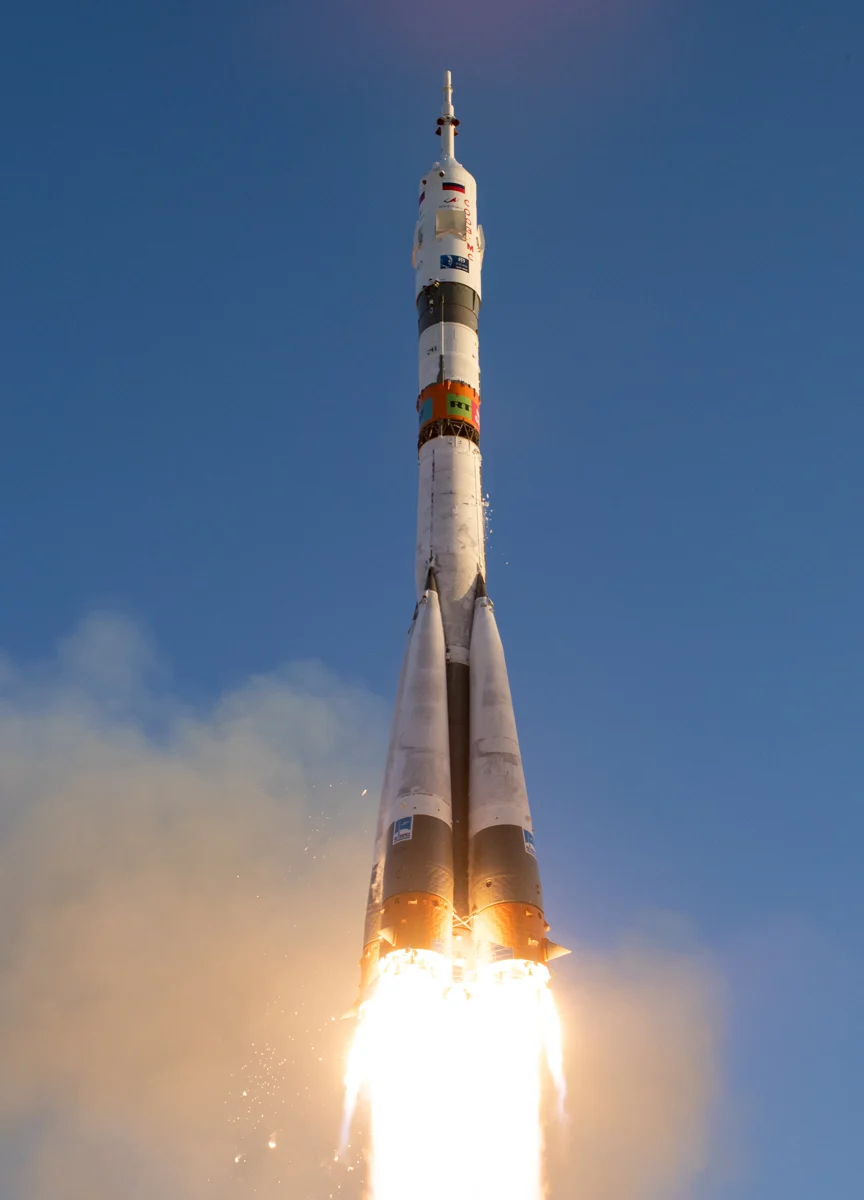
Soyuz names a launcher family and a separate spacecraft family. Together they connect several generations of space stations.
USSR / RussiaCountry or programme
1966First flight / test
Has carried humansHuman spaceflight
Soyuz lifts off with the Expedition 75 crew. · NASA/Bill Ingalls · Source · Public domain · Resized and converted to WebP; original proportions preserved.
A history of launches
The Soyuz launcher first flew in 1966 with an uncrewed spacecraft. The programme suffered difficult beginnings, including Vladimir Komarov’s death during the return of Soyuz 1 in 1967.
Successive versions later supported Salyut, Mir and the ISS. The same technical lineage also launched satellites and Progress cargo vehicles.
Missions and crews
Selected representative missions; crew names belong to the flight shown.
1975-07-15
Soyouz 19 · Apollo-Soyouz
The Soviet spacecraft docked with Apollo in a symbolic meeting between the two space powers.
Crew of this missionAlexeï Leonov · Valeri Koubassov
2000-10-31
Soyouz TM-31 · Expedition 1
The first permanent ISS crew reached the station aboard the Soyuz TM-31 spacecraft.
Crew of this missionIouri Guidzenko · Sergueï Krikaliov · William Shepherd
Dates follow the days reported by the source agencies, generally in local time; the UTC day can differ. Crews belong to the selected missions, not every flight in the family.
What this work changed
The family demonstrates how an architecture can evolve progressively instead of being replaced entirely with each generation.
First flight or first test of the family, including unsuccessful or suborbital attempts.