A family connecting Baikonur with an equatorial platform.
Zenit is developed within the Soviet space programme by industry based in Ukraine. It launches satellites from land and later becomes the basis of the maritime Sea Launch system.
USSR / Ukraine, international cooperationCountry or programme
1985First flight / test
No crewed flightHuman spaceflight
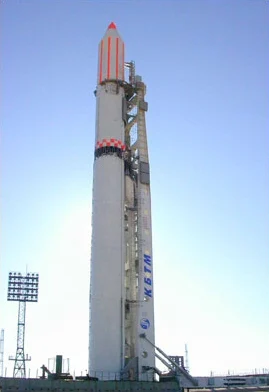
Zenit-2 on the launch pad at Baikonur in 2001. · NASA · Source · Public domain · Resized and converted to WebP; original proportions preserved.
A history of launches
Its first flight takes place in 1985. The family shares engineering choices with Energia's boosters, including powerful liquid-oxygen and kerosene propulsion.
The Sea Launch consortium subsequently brings together Ukrainian, Russian, American and Norwegian partners. In 1999, a three-stage version lifts off from a mobile platform in the equatorial Pacific.
Missions and crews
Selected representative missions; crew names belong to the flight shown.
1985
Premier vol / First flight
The family's first attempt launches from Baikonur; development continues with improved versions.
Crew of this missionUncrewed mission
1999
Sea Launch · vol de démonstration
Sea Launch's demonstration validates the principle of an orbital launch from an ocean platform.
Crew of this missionUncrewed mission
Dates follow the days reported by the source agencies, generally in local time; the UTC day can differ. Crews belong to the selected missions, not every flight in the family.
What this work changed
Zenit illustrates both international connections in space technology and the variety of possible launch infrastructure.
First flight or first test of the family, including unsuccessful or suborbital attempts.