
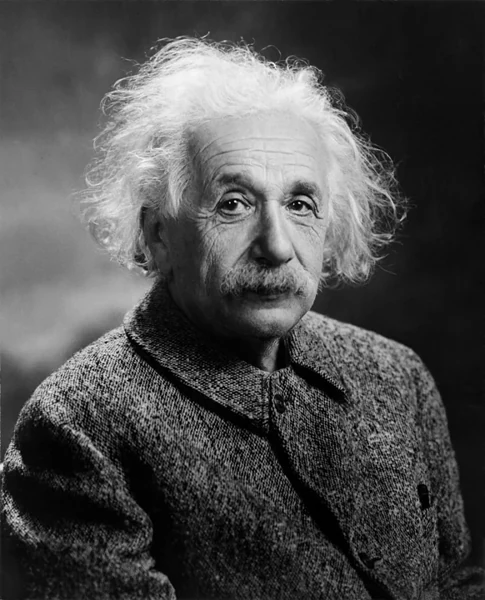

A life of research
Born in Ulm, he studied in Switzerland and worked at the Bern patent office before entering academic life. His 1905 papers addressed light, microscopic motion and special relativity, among other fundamental questions.
Special relativity connects measurements of space and time made by moving observers. Einstein then extended his thinking to acceleration and gravitation, completing the general theory of relativity in 1915.
Understanding the contribution
In this theory, matter and energy curve spacetime, and objects and light follow that geometry. It explains an anomaly in Mercury's orbit and predicts that light bends when it passes close to the Sun.
The equations enable models of an evolving Universe, descriptions of black holes and predictions of gravitational waves. Many other scientists developed these consequences through mathematical work and observation.