
Welcome to Universum.luUniversum · The astronomy portal
The portal / Isaac Newton · Great figures
One gravity on Earth and in the sky

Isaac Newton

1643–1727

Newton connected falling objects and planetary orbits through laws of motion and universal gravitation. Mechanics became a predictive language for astronomy, linking familiar experience to celestial motion.

← Back to all portraits
Isaac Newton
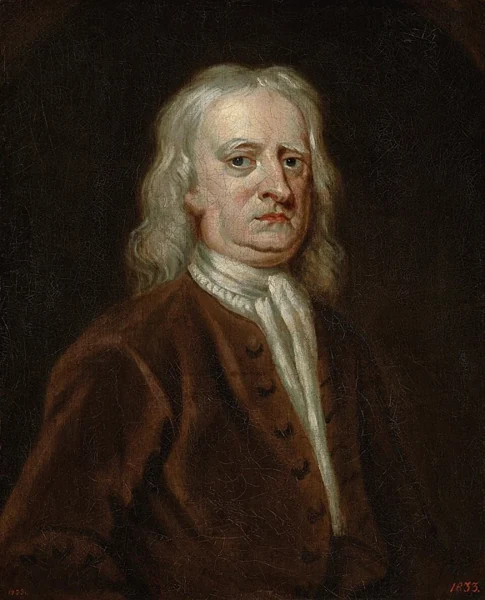
Painted portrait of Newton by John Vanderbank, formerly attributed to Godfrey Kneller.
John Vanderbank / Formerly attributed to Godfrey Kneller · Public domain · Portrait source
Resized and converted to WebP for this site.

A life of research

Born in England in 1643 by the Gregorian calendar, he studied and taught at Cambridge. His research ranged across mathematics, optics and motion.

He built a reflecting telescope and investigated the separation of white light into colours. Encouraged and supported by Edmond Halley, he published the Principia in 1687.

Understanding the contribution

Gravitational attraction depends on masses and decreases with the square of distance. Combined with the laws of motion, it explains Kepler’s patterns and permits the calculation of new trajectories.

An orbit can therefore be understood as continuous falling around a celestial body. The theory works remarkably well in many situations, although general relativity is needed for certain precise or extreme effects.

What this work changed

Newton united terrestrial and celestial physics, giving astronomy a powerful means of prediction and verification.

Sources and references