
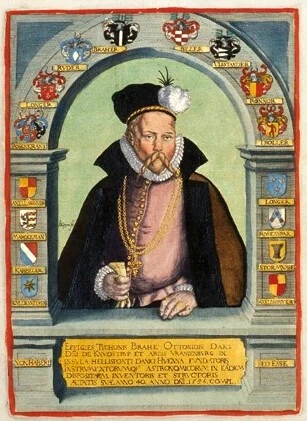

A life of research
Born into a Danish noble family, he pursued astronomy after university studies. On the island of Hven he established Uraniborg, a centre for observations, instrument making and astronomical calculations.
Late in life he moved to Prague to work under Emperor Rudolf II. Johannes Kepler joined his team there in 1600, beginning a short collaboration with far-reaching consequences for astronomy.
Understanding the contribution
In 1572 Tycho observed a new star, now understood as a supernova. Its lack of measurable parallax placed it beyond the Moon and challenged the idea that the distant heavens never changed.
He subsequently measured stellar and planetary positions systematically without a telescope. He supported a model in which the Sun orbited Earth while the other planets orbited the Sun, rather than the model Kepler eventually adopted.