One name spanning several generations of launch vehicles.
The Delta lineage begins in 1960 using technology derived from the Thor missile. It changes profoundly: a Delta IV Heavy is not simply an enlarged copy of the first Delta.
United StatesCountry or programme
1960First flight / test
No crewed flightHuman spaceflight
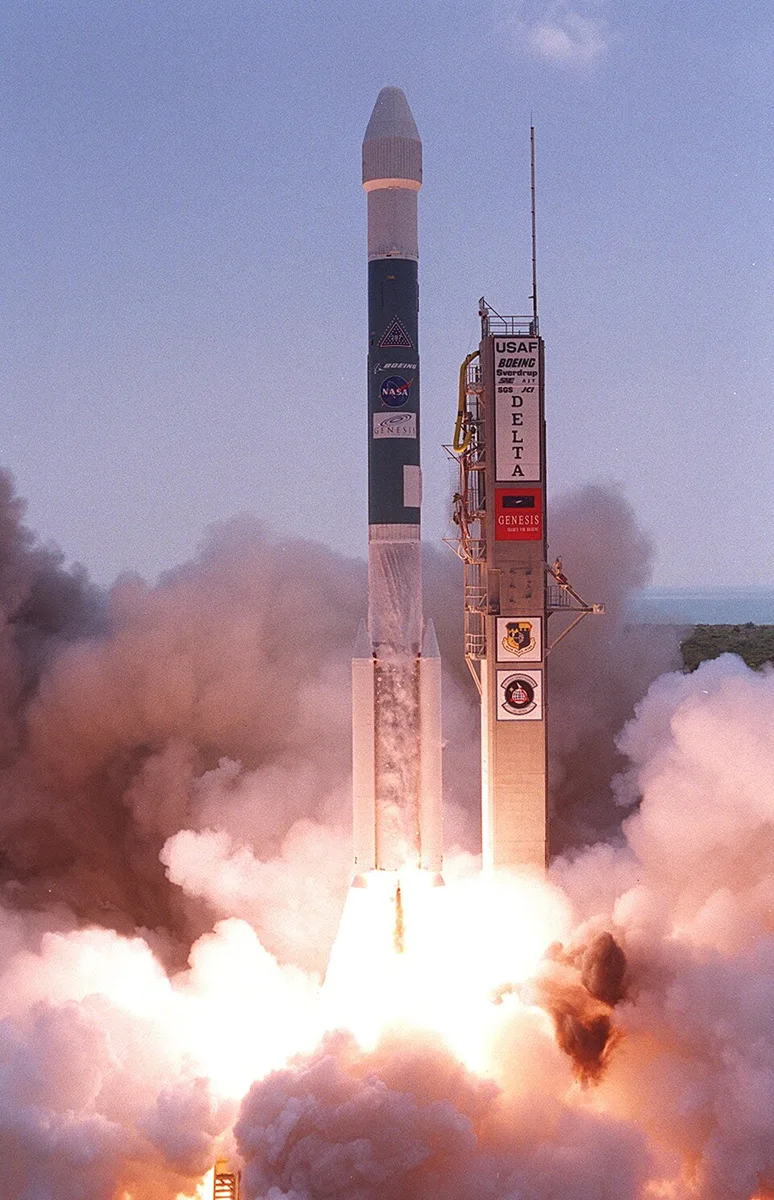
Delta II · Genesis · 2001 · NASA/KSC · Source · Public domain · Image resized and converted to WebP.
A history of launches
Early vehicles serve communications and research. Over the following decades, their successors launch many scientific satellites and exploration probes, always without crews.
Delta II becomes a mainstay of robotic missions; Delta IV introduces a different architecture using hydrogen and oxygen engines. Its Heavy version joins three large rocket cores together.
Missions and crews
Selected representative missions; crew names belong to the flight shown.
1960-08-12
Echo 1A
The reflective Echo 1A balloon enables experiments in bouncing radio signals across long distances.
Crew of this missionUncrewed mission
2018-08-12
Parker Solar Probe · Delta IV Heavy
Delta IV Heavy launches Parker Solar Probe; no astronauts travel aboard the spacecraft.
Crew of this missionUncrewed mission
Dates follow the days reported by the source agencies, generally in local time; the UTC day can differ. Crews belong to the selected missions, not every flight in the family.
What this work changed
The family traces changing spaceflight requirements, from pioneering satellites to demanding interplanetary departures.
First flight or first test of the family, including unsuccessful or suborbital attempts.