The portal / Space Shuttle · Rockets and astronauts
Human spaceflight
Space Shuttle
A launch system, laboratory and orbital glider.
The American shuttle combines a crewed orbiter, an external tank and two solid boosters. Space Shuttle means the complete system, rather than only the winged spacecraft visible in photographs.
United StatesCountry or programme
1981First flight / test
Has carried humansHuman spaceflight
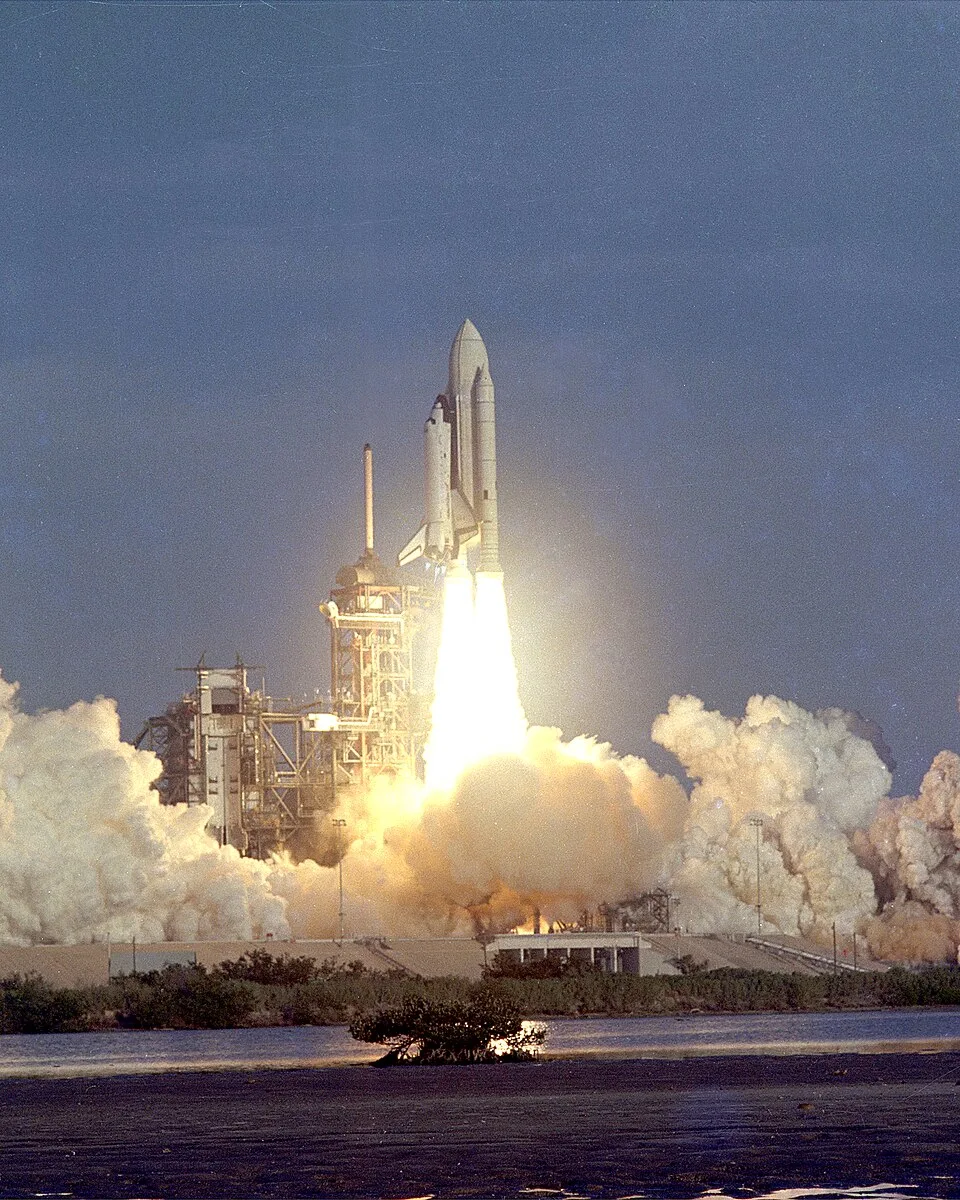
Columbia · STS-1 · 1981 · NASA · Source · Public domain · Image resized and converted to WebP.
A history of launches
Between 1981 and 2011, shuttles deploy satellites, conduct experiments and help assemble the International Space Station. They also enable astronauts to service Hubble directly in orbit.
Reuse is partial and requires extensive maintenance. The Challenger disaster in 1986 and Columbia disaster in 2003 each kill seven astronauts and profoundly shape the programme.
Missions and crews
Selected representative missions; crew names belong to the flight shown.
1981-04-12
STS-1 · Columbia
Young and Crippen make Columbia's first orbital flight and test its runway landing.
Crew of this missionJohn Young · Robert Crippen
2011-07-08
STS-135 · Atlantis
Atlantis supplies the ISS on the final mission of the shuttle programme.
Crew of this missionChristopher Ferguson · Douglas Hurley · Sandra Magnus · Rex Walheim
Dates follow the days reported by the source agencies, generally in local time; the UTC day can differ. Crews belong to the selected missions, not every flight in the family.
What this work changed
Its missions transform human work in orbit and reveal the demanding safety requirements of reusable spacecraft.
First flight or first test of the family, including unsuccessful or suborbital attempts.