
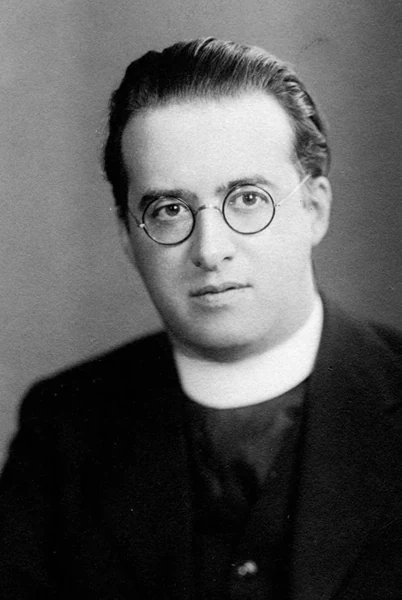

A life of research
Born in Belgium, he studied mathematics and physics, became a priest and continued his scientific training in Cambridge and the United States. He later taught at the University of Louvain.
He treated scientific questions through their own methods. His research combined Einstein's equations with available astronomical measurements at a time when the idea of a static cosmos remained influential.
Understanding the contribution
In 1927 he described an expanding Universe and related the recession speeds of galaxies to their distances. The distance estimates were still uncertain, but linking theoretical evolution with observations was a crucial step.
In 1931 he suggested an initially concentrated state, the primeval atom. This was not yet the modern cosmological model, but it encouraged scientists to investigate a physical history of the observable Universe.