
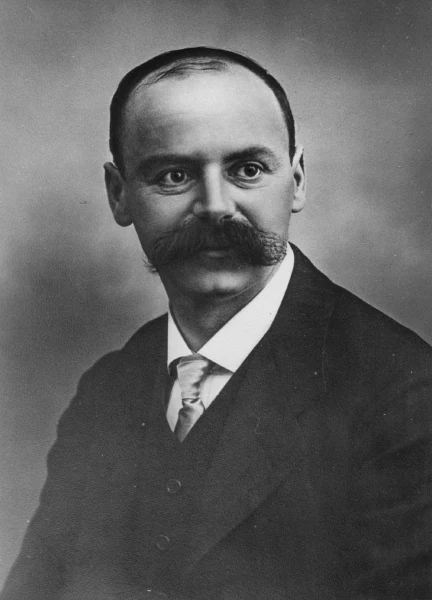

A life of research
Born in Frankfurt, he developed an early interest in astronomy. He worked in Göttingen and later at Potsdam Observatory, investigating subjects including the measurement of stellar brightness and the physics of radiation.
His research combined practical observation with mathematical reasoning. While serving during the First World War, he learned of Einstein's newly completed general theory of relativity, published at the end of 1915.
Understanding the contribution
In 1916 he obtained the first exact solution for the gravitational field outside a spherical, non-rotating mass. The solution allows trajectories and relativistic effects to be calculated in this particularly simple situation.
It contains a characteristic length now called the Schwarzschild radius. For an ideal black hole without rotation or electric charge, this radius marks the horizon, beyond which light cannot reach a distant observer.