
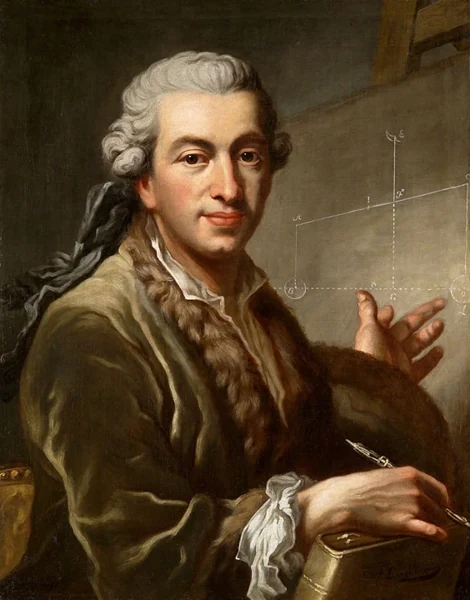

A life of research
Born in Normandy, he moved to Paris and built a scientific career during a period of major political change. His research extended across mechanics, probability and mathematical physics.
He assembled much of his work in the Treatise on Celestial Mechanics, published from 1799 to 1825. It developed Newton's laws into powerful methods for calculating the behaviour of systems containing multiple objects.
Understanding the contribution
Planets feel not only the Sun's attraction but also each other's gravity. Laplace studied these perturbations to explain changes in their orbits and investigate the stability of the Solar System over long periods.
In 1796 he also proposed a hypothesis for planetary formation from a rotating nebula. This historical picture differs in important ways from modern models, but it sought a common physical origin for the system.