

A life of research
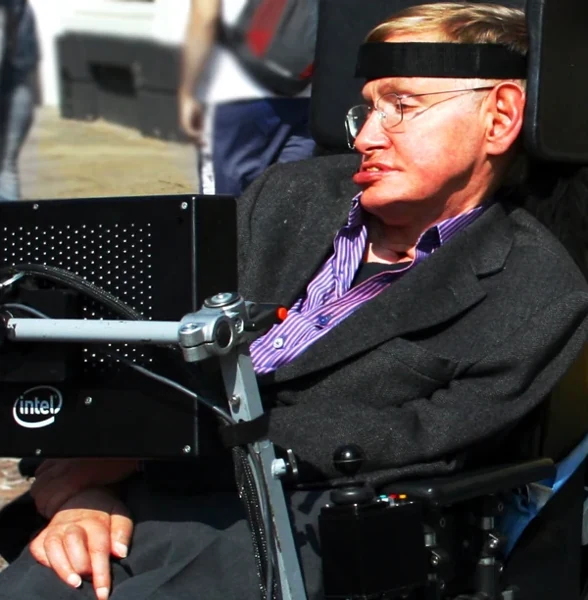
Born in Oxford, he studied there before moving to Cambridge. Living with a progressive neurological illness, he continued his research with human assistance and specially adapted communication technology.
His early work investigated singularities in general relativity, in close intellectual connection with Roger Penrose's research. These studies explored conditions under which classical descriptions of spacetime reach their limits.
Understanding the contribution
In 1974 he showed that quantum effects near an event horizon lead to a temperature and radiation associated with a black hole. An object usually described as completely dark can therefore lose energy.
This theoretical result, known as Hawking radiation, has not been directly observed from astrophysical black holes. It raises fundamental questions about information and about reconciling gravity with quantum mechanics.