
Phobos, the inner moon
The larger moon travels very close to Mars, completing an orbit in about 7 hours 39 minutes. The large Stickney crater dominates its shape. Its orbital period is shorter than Mars’s rotation period.
Two small, irregular moons accompany Mars. Their history remains an open question.
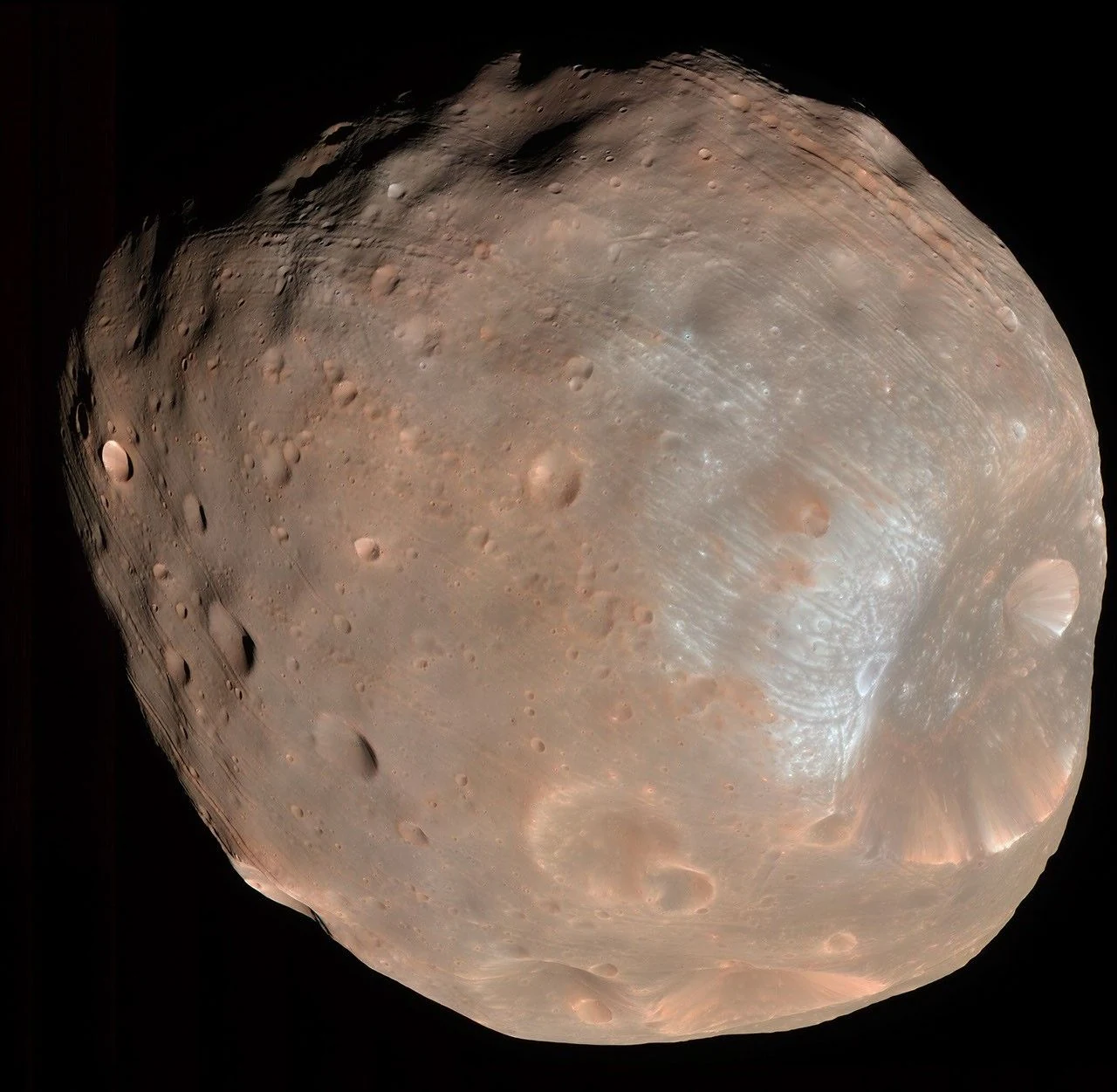
The larger moon travels very close to Mars, completing an orbit in about 7 hours 39 minutes. The large Stickney crater dominates its shape. Its orbital period is shorter than Mars’s rotation period.
Deimos is smaller and farther away, taking about 30 hours to orbit Mars. Its surface looks smoother in images, partly because fine material softens some of its relief.
Asaph Hall discovered both moons in August 1877. Their shapes resemble small asteroids, but their origin is not settled. Capture and formation from debris around Mars are among the scenarios studied.
Both moons are faint and close to dazzling Mars. They are not easy beginner targets. Their inclusion here does not mean they will be visible in small binoculars or every telescope setup.
Space-mission images; mosaics and processing are identified in the credits. NASA/JPL · Image use
Educational reference values and sources checked on 23 October 2026.