
A rocky, living world
The third planet from the Sun is slightly flattened at the poles. Oceans, continents, ice, air and living organisms constantly interact. Earth is the only world where life has been confirmed.
From its metallic core to its clouds: discover the planet from which we observe the Universe.
Recognising clouds ↓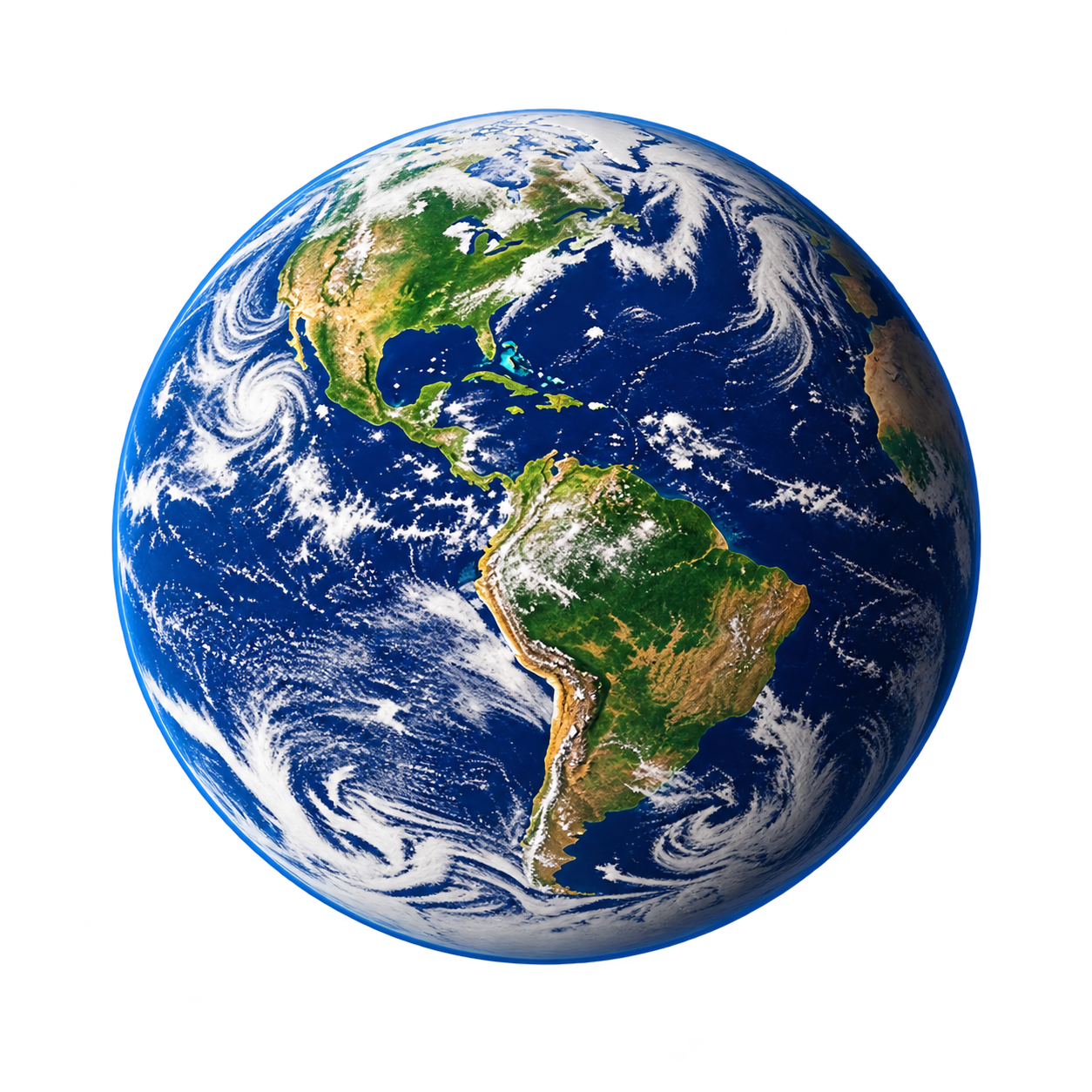
Rounded values: local conditions, seasons and altitude affect many measurements.
The third planet from the Sun is slightly flattened at the poles. Oceans, continents, ice, air and living organisms constantly interact. Earth is the only world where life has been confirmed.
The crust sits above a mostly solid rocky mantle that deforms very slowly. Below it, the metallic outer core is liquid and the inner core is solid. Motion within the outer core helps generate the magnetic field.
Moving lithospheric plates build mountains, trenches and volcanoes where they meet or separate. Water circulates between oceans, air, ground, rivers and ice through evaporation, condensation, precipitation and runoff.
Rotation produces day and night. A mean solar day lasts 24 hours, slightly longer than one turn relative to the stars because Earth also moves along its orbit. Axial tilt changes the Sun’s height and day length, producing opposite seasons in the two hemispheres.
Near the ground, dry air is about 78.08% nitrogen, 20.95% oxygen and 0.93% argon, with CO₂ and other trace gases making up the remainder. Water vapour varies and is excluded from these percentages.
The atmosphere transports heat and moisture. Water vapour, CO₂ and other gases absorb some of Earth’s outgoing infrared radiation: this natural greenhouse effect warms the surface. Human-driven increases in greenhouse gases strengthen it.
Open a layer to learn its role. Heights are approximate and the graphic is not to scale. The ionosphere, defined by charged particles, overlaps several thermal layers.
The outer envelope gradually merges into space. The atmosphere has no sharp edge; its boundaries vary with solar activity.
The air is extremely thin. Absorbed energetic radiation raises particle temperatures, but high temperature here does not mean the warmth we feel in dense air.
Temperature falls again. Many meteors glow and break apart here. Noctilucent clouds can appear near its top.
It contains most atmospheric ozone, which absorbs some solar ultraviolet radiation. Temperature generally rises with height.
Almost all weather and clouds occur here. Its top varies with latitude and season; temperature usually decreases with height.
Weather describes conditions at a particular time and place; climate describes long-term statistics, often over 30 years. Köppen classification uses temperature and rainfall to distinguish five main groups. Latitude, relief, oceans and air circulation shape their diversity.
Warm throughout the year, with equatorial rainfall or alternating wet and dry seasons in savannas.
Rainfall does not meet evaporative demand. Deserts and steppes may be hot or cold.
Relatively mild winters; includes oceanic, Mediterranean and humid subtropical climates.
Cold winters and pronounced seasonal contrasts, especially in northern continental interiors.
The warmest month averages below 10°C. Tundra and ice-cap climates differ.
Altitude and exposure modify local climates. Mountains are not a sixth main Köppen group; they create elevation zones within a regional climate.
A cloud contains water droplets, ice crystals or both; water vapour itself is invisible. Cooling moist air favours condensation or ice formation. WMO recognises ten main genera, which alone cannot provide a weather forecast.
Approximate levels for temperate regions, following WMO guidance. Levels overlap and are lower near the poles and higher in the tropics. Drawings are educational silhouettes, not to scale.
10 genera shown
Thin white, feather-like streaks made of ice crystals.
See WMO definition ↗Tiny white grains or ripples, usually without strong shading.
See WMO definition ↗A translucent whitish veil; its crystals can produce a halo around the Sun or Moon.
See WMO definition ↗White and grey rounded patches or rolls, larger than cirrocumulus elements.
See WMO definition ↗A grey or blue-grey sheet; thinner parts may show the Sun as through frosted glass.
See WMO definition ↗A thick dark layer often bringing persistent rain or snow; it may span several levels.
See WMO definition ↗Large low grey and white rolls or heaps, with gaps or joined into a layer.
See WMO definition ↗A low uniform grey layer, sometimes with drizzle. Fog reaches the ground.
See WMO definition ↗Separate cauliflower-shaped clouds, often with flat bases. Small fair-weather clouds can grow vertically.
See WMO definition ↗A towering cloud, often with an anvil top, associated with thunderstorms, heavy showers and sometimes hail.
See WMO definition ↗A cloudless sky is not necessarily steady. Haze and aerosols affect transparency; turbulence blurs telescopic detail and makes stars twinkle. Cirrus can dim objects without hiding them. Record cloud cover, transparency and steadiness in your journal to compare observing nights.
Clouds are never a safe solar filter: do not view the Sun through an instrument without a suitable front-mounted solar filter. Stop observing and seek shelter during thunderstorms.
Universum · 23.10.2026