
1957
Robotic missions
Sputnik 1
USSR
On 4 October 1957, the first artificial Earth satellite reached orbit. Its radio signals marked the dawn of the space age: a human-made object was circling the world.
Leaving Earth. Learning to live in orbit. Walking on the Moon. Discover journeys that changed our view of the Universe.
1957 — 2023
A selection of landmark missions and programmes, ordered by the first milestone described. A programme such as Apollo includes several missions; a mission is a specific flight or scientific undertaking. This is a historical introduction, not a complete flight register or a live operations tracker.
18 milestones shown
No results. Try another name or reset the filters.
USSR
On 4 October 1957, the first artificial Earth satellite reached orbit. Its radio signals marked the dawn of the space age: a human-made object was circling the world.
USSR
On 12 April 1961, Yuri Gagarin made the first human spaceflight aboard Vostok 1. In June 1963, Valentina Tereshkova became the first woman in space aboard Vostok 6.
NASA
Mercury taught the United States how to send an astronaut into space and bring him home. Alan Shepard flew a suborbital mission on 5 May 1961; John Glenn became the first American in orbit on 20 February 1962.
NASA
Ten crewed flights in 1965 and 1966 prepared the way for Apollo. Two-person crews practised longer stays, spacewalks, orbital rendezvous and docking.
NASA
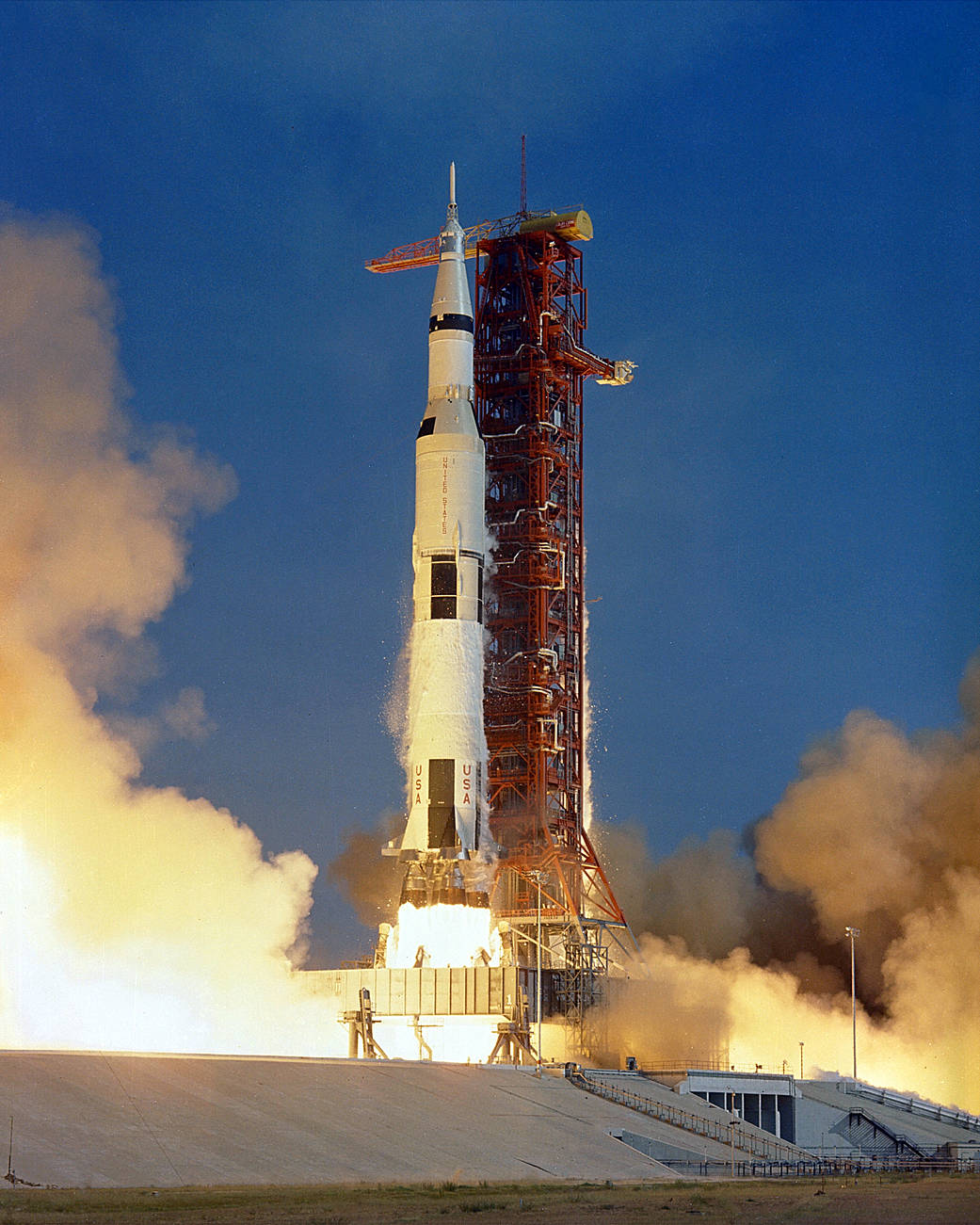
From 1968 to 1972, eleven crewed flights progressed from Earth orbit to the lunar surface. Six missions landed successfully and twelve astronauts walked on the Moon. Apollo combined exploration, geology and deep-space flight experience. 7 1968 Crewed command module test in Earth orbit. 8 1968 First crew to orbit the Moon, in December. 9 1969 Crewed lunar module test in Earth orbit. 10 1969 Lunar dress rehearsal without landing. 11 1969 Landing on 20 July. Armstrong and Aldrin explore the surface; Collins remains in orbit. Armstrong’s first step is on 21 July UTC. 12 1969 Precision landing near the Surveyor 3 probe. 13 1970 Landing cancelled after an explosion; all three astronauts return safely. 14 1971 Exploration of the Fra Mauro region. 15 1971 First Apollo lunar rover, in the Hadley–Apennine region. 16 1972 Study of the Descartes Highlands. 17 1972 Exploration of Taurus–Littrow with geologist Harrison Schmitt; final landing of the programme.
NASA
Launched on 14 May 1973, the first US space station hosted three crews in 1973–1974. Astronauts repaired launch damage, observed the Sun and studied the effects of extended weightlessness.
NASA · USSR
On 17 July 1975, an American Apollo and a Soviet Soyuz spacecraft docked in orbit. Their crews met and conducted joint experiments, marking a symbolic and technical step in space cooperation.
NASA / JPL
Launched in 1977, the two probes explored the giant planets. Voyager 2 visited Jupiter, Saturn, Uranus and Neptune. Their journey extended exploration into interstellar space and revealed diverse moons and rings.
NASA
Between 1981 and 2011, US shuttles flew 135 missions involving laboratories, satellites, Hubble servicing and ISS assembly. The losses of Challenger in 1986 and Columbia in 2003 remain reminders of the human cost and risks of spaceflight.
USSR / Russia
Mir’s first module launched in February 1986. The modular station became a laboratory for long-duration stays and international cooperation, including Shuttle–Mir. It was deorbited in a controlled re-entry in March 2001.
NASA · ESA
Launched aboard Discovery on 24 April 1990, Hubble observes the Universe above the atmosphere. Servicing missions, including the 1993 optical correction, showed how astronauts could extend the capabilities of a scientific observatory.
NASA · Roscosmos · ESA · JAXA · CSA
Assembly of the International Space Station began in 1998. Its first resident crew arrived on 2 November 2000. The orbital laboratory supports research on microgravity, human health, materials and Earth observation.
China / CMSA
On 15 October 2003, Yang Liwei launched aboard Shenzhou 5. China became the third nation to send a human into space with its own spacecraft and launcher, paving the way for a crewed programme and orbital stations.
ESA · DLR · CNES · ASI
Launched in 2004, Rosetta reached comet 67P in August 2014. Philae landed on its nucleus on 12 November 2014. The orbiter then followed the comet around the Sun, studying its gases, dust and activity.
JAXA
Launched in December 2014, Hayabusa2 explored asteroid Ryugu and collected material. Its capsule returned samples to Earth in December 2020, enabling detailed analysis with laboratory instruments.
NASA · ESA · CSA
Launched on 25 December 2021, Webb observes mainly in infrared from an orbit around Sun–Earth L2. It studies early galaxies, star formation and exoplanet atmospheres.
NASA · ESA
From 16 November to 11 December 2022, this uncrewed test flight demonstrated SLS and Orion. Orion travelled beyond the Moon and returned to Earth, using a European Service Module supplied by ESA.
ISRO
Launched on 14 July 2023, the Indian mission landed at high southern lunar latitudes on 23 August. Lander Vikram and rover Pragyan investigated the site. India became the fourth nation to achieve a soft lunar landing.
Apollo progressed through tests, rendezvous and exploration. Crewed flights Apollo 7 to 17 took place from 1968 to 1972. The six lunar landings were Apollo 11, 12, 14, 15, 16 and 17.
| Mission | Year | Objective and outcome |
|---|---|---|
| Apollo 7 | 1968 | Crewed command module test in Earth orbit. |
| Apollo 8 | 1968 | First crew to orbit the Moon, in December. |
| Apollo 9 | 1969 | Crewed lunar module test in Earth orbit. |
| Apollo 10 | 1969 | Lunar dress rehearsal without landing. |
| Apollo 11 | 1969 | Landing on 20 July. Armstrong and Aldrin explore the surface; Collins remains in orbit. Armstrong’s first step is on 21 July UTC. |
| Apollo 12 | 1969 | Precision landing near the Surveyor 3 probe. |
| Apollo 13 | 1970 | Landing cancelled after an explosion; all three astronauts return safely. |
| Apollo 14 | 1971 | Exploration of the Fra Mauro region. |
| Apollo 15 | 1971 | First Apollo lunar rover, in the Hadley–Apennine region. |
| Apollo 16 | 1972 | Study of the Descartes Highlands. |
| Apollo 17 | 1972 | Exploration of Taurus–Littrow with geologist Harrison Schmitt; final landing of the programme. |
Each entry links to an institutional source. Dates identify the milestone described in the text. The Apollo table draws on NASA archives. Launch photograph: NASA, reused with credit. Historical selection prepared on 23 October 2026.
Back to top ↑