
The sol and the year
A Martian solar day, called a sol, lasts about 24 hours 39 minutes. One orbit around the Sun lasts about 687 Earth days. The same calendar date therefore does not correspond to the same Martian season each year.
An almost Earth-length day, an almost twice-as-long year and seasons unlike our own.
A Martian solar day, called a sol, lasts about 24 hours 39 minutes. One orbit around the Sun lasts about 687 Earth days. The same calendar date therefore does not correspond to the same Martian season each year.
An axial tilt near 25° produces opposite seasons in the two hemispheres. The elliptical orbit makes their lengths unequal. Northern spring and summer last longer than their southern counterparts.
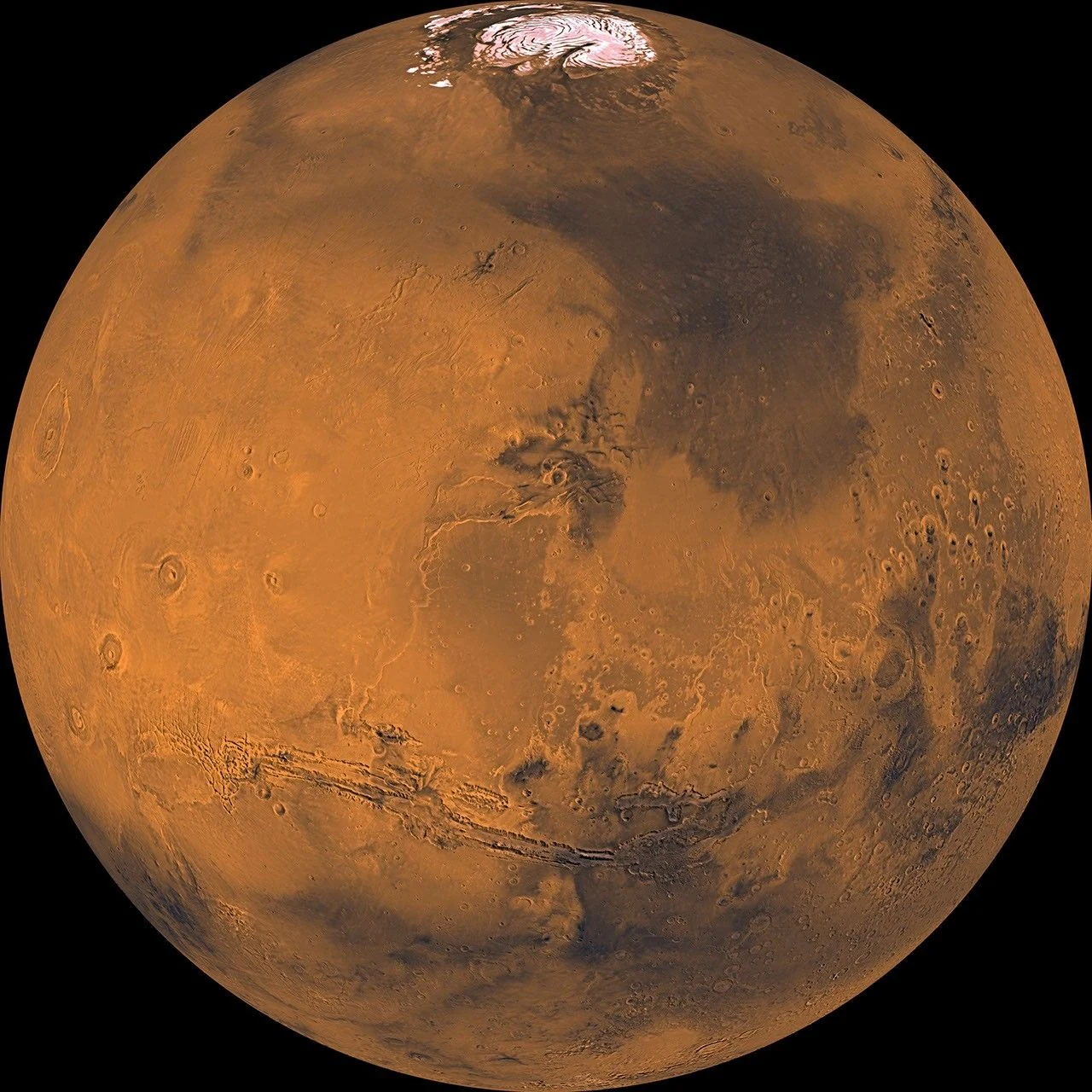
Dust storms can be local, regional or planet-encircling. They alter telescopic contrast and the sunlight reaching the surface. The polar caps contain water ice and seasonal carbon-dioxide ice deposits.
The presence of ice is well established. A dark streak alone is not proof of flowing liquid water: dry granular movement can produce some of these patterns. Observations, hypotheses and confirmation must be distinguished.
Space-mission images; mosaics and processing are identified in the credits. NASA/JPL · Image use
Educational reference values and sources checked on 23 October 2026.